Hierarchical Reward Design from Language: Enhancing Alignment of Agent Behavior with Human Specifications

AAMAS 2026
Rice University
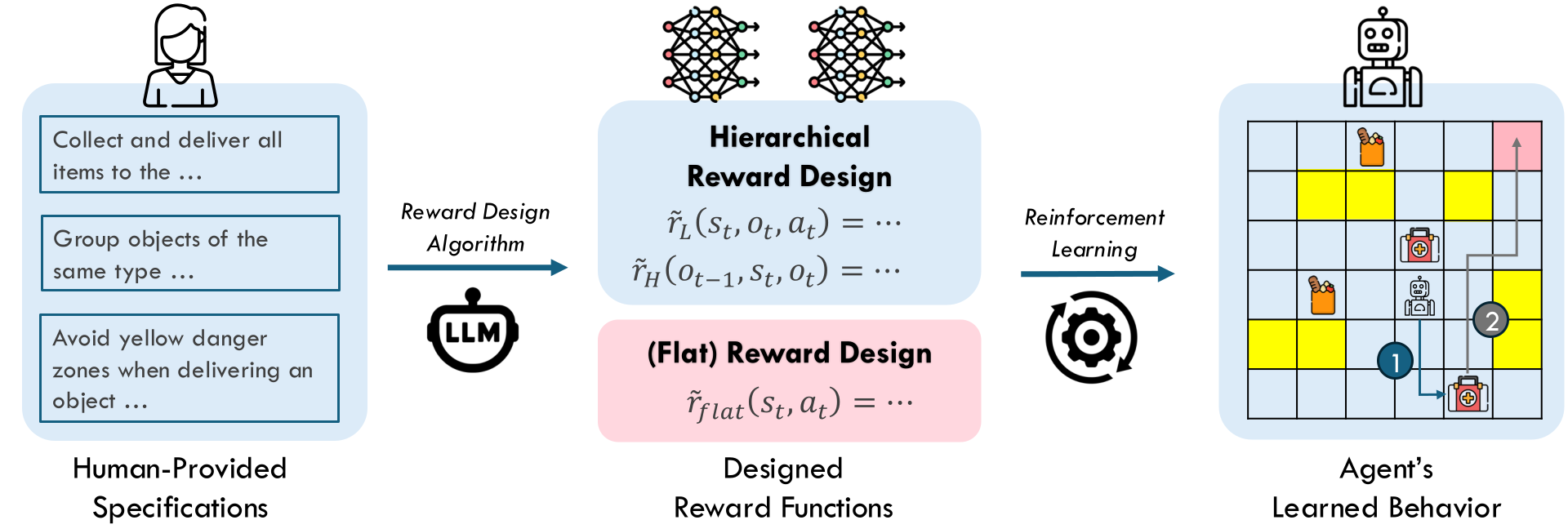
Overview of flat vs. hierarchical reward design

Figure 1. HRDL splits reward design into a high-level reward and a low-level reward. L2HR, our approach, uses language models to turn a person's written specification into these rewards.

TL;DR: Long-horizon behavior specifications are about what subtasks an agent does, in which order, and how. We formalize reward design for hierarchical RL agents and show that LLM-generated hierarchical rewards align agents with language specifications far better than flat rewards.

Abstract

When training artificial intelligence (AI) to perform tasks, humans often care not only about whether a task is completed but also how it is performed. As AI agents tackle increasingly complex tasks, aligning their behavior with human-provided specifications becomes critical for responsible AI deployment. Reward design provides a direct channel for such alignment by translating human expectations into reward functions that guide reinforcement learning (RL). However, existing methods are often too limited to capture nuanced human preferences that arise in long-horizon tasks. Hence, we introduce Hierarchical Reward Design from Language (HRDL): a problem formulation that extends classical reward design to encode richer behavioral specifications for hierarchical RL agents. We further propose Language to Hierarchical Rewards (L2HR) as a solution to HRDL. Experiments show that AI agents trained with rewards designed via L2HR not only complete tasks effectively but also better adhere to human specifications. Together, HRDL and L2HR advance the research on human-aligned AI agents.

Why Hierarchical Reward Design?

People naturally break long tasks into subtasks, and hierarchical RL agents are built the same way: a high-level policy selects which subtask (an option) to pursue, and a low-level policy selects the actions that carry it out. However, reward design for hierarchical agents remains largely unexplored.

Consider the Rescue World specification from Figure 1. It constrains three different aspects of the agent's behavior:
What

Which subtasks to perform

“Collect and deliver all supplies in the environment.”

Captured by the task reward.
Which order

How subtasks are sequenced

“Group objects of the same type: deliver all supplies of one type before switching.”

Depends on the previous subtask.
How

How each subtask is executed

“Avoid yellow danger zones when delivering an object.”

Can depend on the current subtask.

Existing reward design methods produce a single flat reward, which scores each action based only on the current state. It can't tell which subtask the agent is pursuing or has just finished, so it can't fully capture the second and third kinds of specification. Prior work on hierarchical RL usually assumes hierarchical rewards are given; HRDL formalizes how to design them.

Venn diagram: HRDL lies at the intersection of hierarchical reinforcement learning and reward design from language Hierarchical Reinforcement Learning Reward Design from Language HRDL

Hierarchical Reward Design (HRD)

HRD replaces the single flat reward with two rewards that also take the agent's options as input: a high-level reward for option selection, and a low-level reward for the actions taken while executing an option.

Reward Inputs What it rewards
FlatPrior work state action Each action
High-levelHRD previous option state selected option Option selection: which option to execute next
Low-levelHRD state current option action Each action, given the option being executed

Highlighted inputs carry option information that a flat reward never receives.

Hierarchical rewards can express more than flat rewards

Any flat reward is a special case of a hierarchical one that ignores its option inputs. The reverse isn't true: some specifications, such as the “which order” example in the previous section, can only be expressed with the option inputs (Properties 1 and 2, Appendix B.3).

From language to rewards (HRDL)

HRDL keeps the rewards a task already has and adds a designed reward at each level, generated from the user's natural-language specification:

High-level reward = task reward + designed high-level reward
Low-level reward = pseudo-reward for subtask completion + designed low-level reward

Highlighted terms are generated from the natural-language specification.

The task reward and pseudo-reward keep the agent completing the task and its subtasks, while the designed rewards shape how it does so. Each level forms a standard decision process (an MDP per option at the low level, a semi-MDP at the high level), so off-the-shelf RL algorithms can train it: PPO for the low level and DQN-style methods for the high level.

L2HR: Language to Hierarchical Rewards

L2HR prompts an LLM to turn a natural-language specification into executable high- and low-level reward functions. It does this without any feedback during training on whether the agent is actually following the specification.

Prompt components

  1. Task description, including the rough scale of the task reward (but not its code).
  2. Environment code that exposes the state and action spaces.
  3. Option and action spaces, so the LLM can separate option selection (high level) from action selection (low level).
  4. Behavior specification: how the user wants the task done, beyond just completing it.
  5. Formatting and reward design tips.

Example (iTHOR)

Input: natural-language specifications
Task description: The objective is to pick up all apples and eggs on the dining table and place them in the sink...
Environment context: class ThorPickPlaceEnv(gym.Env): ...
Relevant task spaces: The agent's option/subtask space consists of picking up and placing the two types of objects...
Low-level user preference: The agent should avoid the stool while on its way to pick up or drop an egg...
High-level user preference: The agent should pick up an object type that is different from what was previously picked...
Additional info: Do not use function attributes or global variables...
Output: reward functions designed by L2HR
# High-level preference reward
def get_high_level_pref_gpt(state: Dict, prev_option: int, option: int) -> Tuple[float, Dict[str, float]]:
    ...
    return reward, reward_components

# Low-level preference reward
def get_low_level_pref_gpt(state: Dict, option: int, action: int) -> Tuple[float, Dict[str, float]]:
    ...
    return reward, reward_components

Two-stage training

Stage 1 · Low level

The LLM generates several candidate low-level designed rewards (8 in our experiments), and each one is used to train a low-level policy. Only the policies that still complete their subtasks are kept.

Stage 2 · High level

The LLM then generates candidate high-level designed rewards, each used to train a high-level policy on top of one of the kept low-level policies. Reward pairs whose agents still complete the task are returned.

Domains

We evaluate on three long-horizon domains. In Rescue World and iTHOR, some specifications can't be captured by a flat reward; in Kitchen, they can.

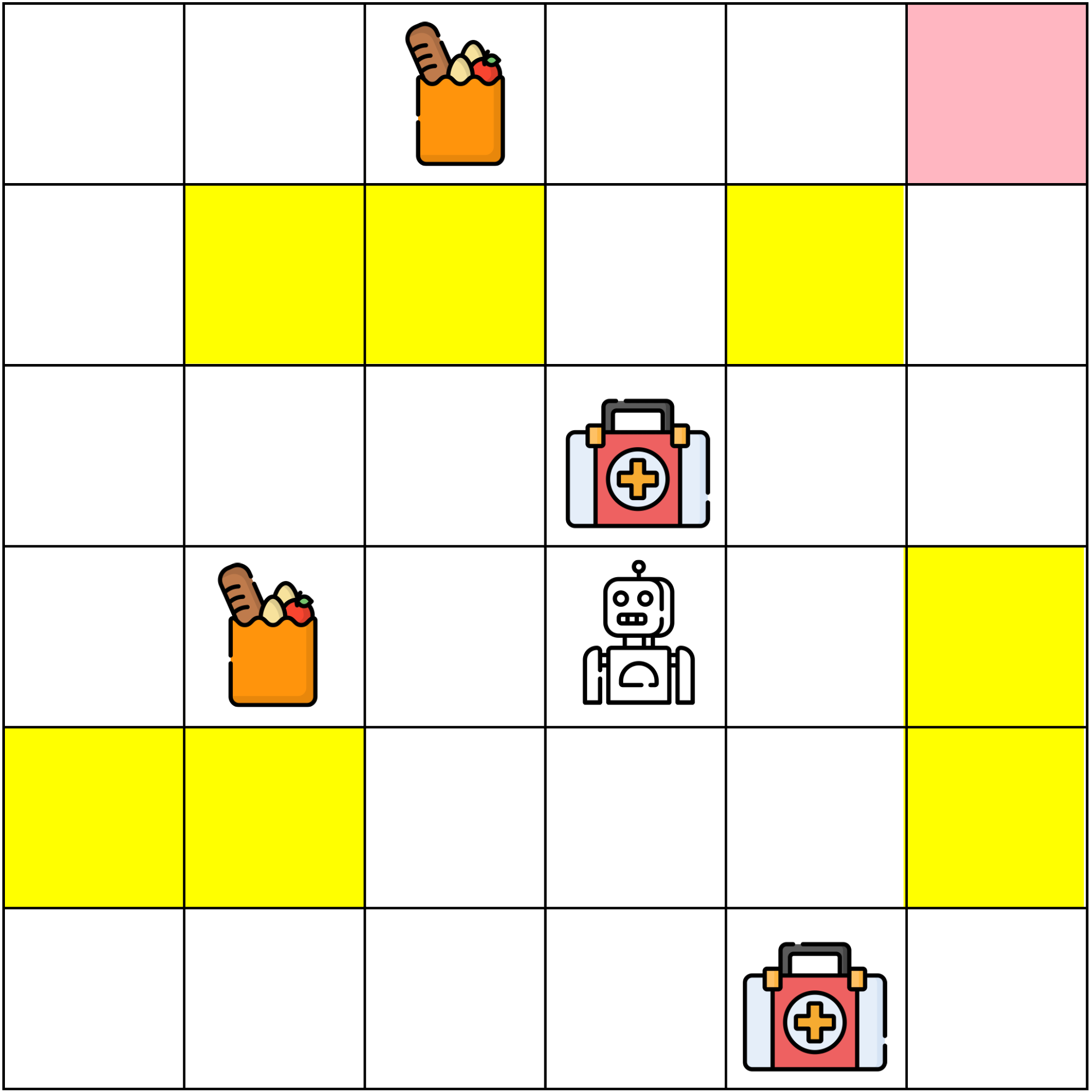
Rescue World domain

Rescue World

Variant of RW4T · 407-dim state · 8 subtasks

Deliver all supplies on a disaster-response map.

High-levelPersistence: deliver all objects of one type before switching to the other type.
Low-levelSafety: avoid the yellow danger zones while delivering an object.
iTHOR domain

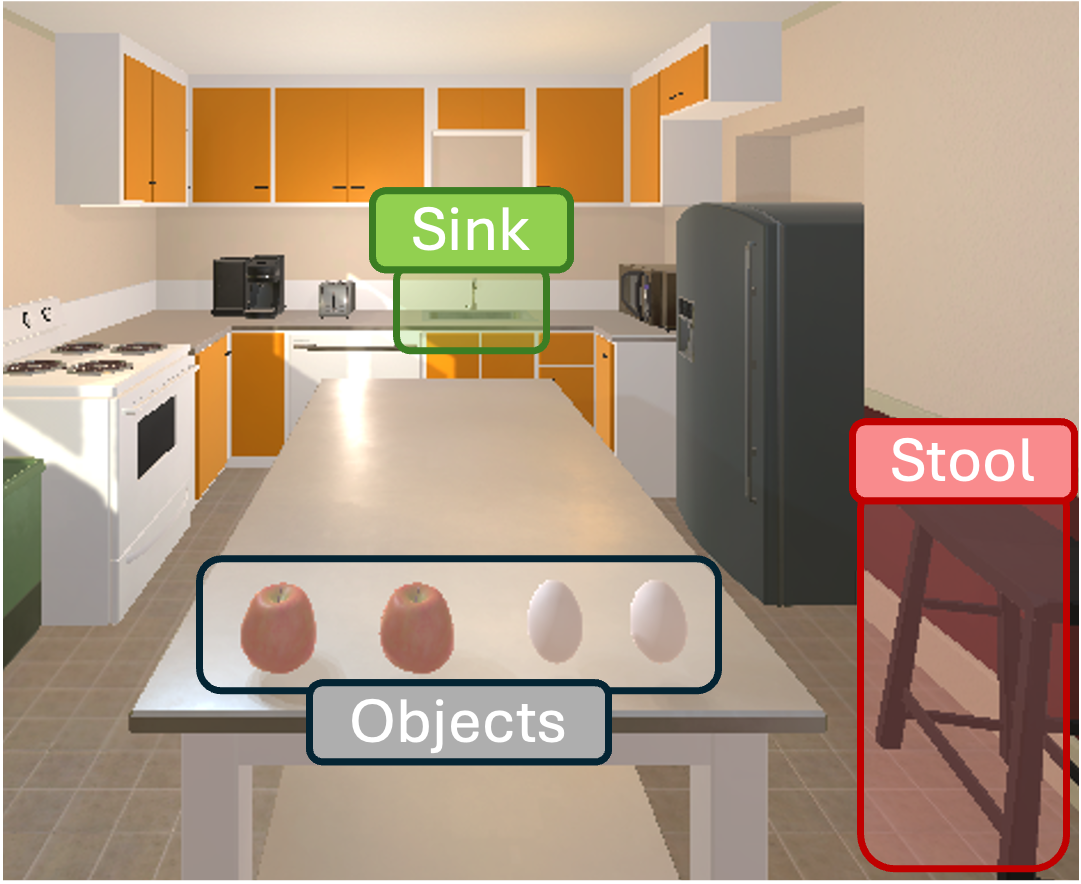
iTHOR

AI2-THOR kitchen · 30-dim state · 8 subtasks

Move all apples and eggs from the dining table to the sink.

High-levelDiversity: alternate between apples and eggs while both remain on the table.
Low-levelAvoidance: stay away from the stool on the way to pick up or place an egg.
Kitchen domain

Kitchen

Overcooked · 699-dim state · 5 subtasks

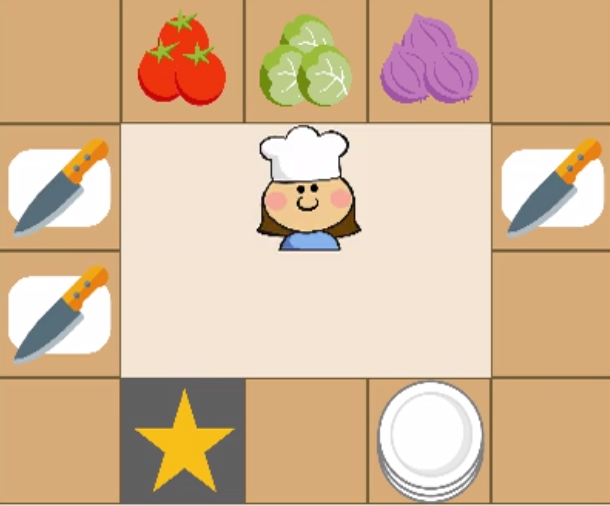
Prepare a salad from a tomato, an onion, and a lettuce.

High-levelChopping order: chop the tomato first, then the onion, then the lettuce.
Low-levelNo specification; the low-level policies are fixed.

Results

We compare L2HR (Hier) against two baselines: an LLM that generates a flat reward from the same specification (Flat), and an agent trained on the task reward alone (Task). Each LLM-based method produces 24 reward candidates.

Q1Is the generated code valid?

Syntax error rates

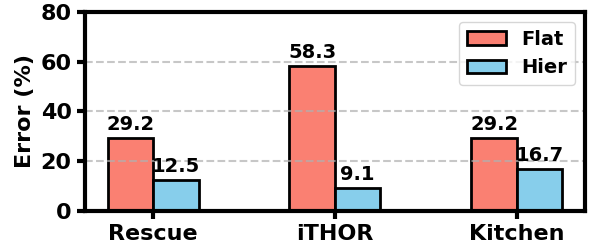
Figure 5. Syntax error rates for LLM-based reward generation.

Hierarchical reward code has far fewer syntax errors in every domain.

Without access to the previous subtask, the flat approach often invents variables that don't exist, such as last_delivered_type.

Q2Can the agent still finish the task?

Task completion rates

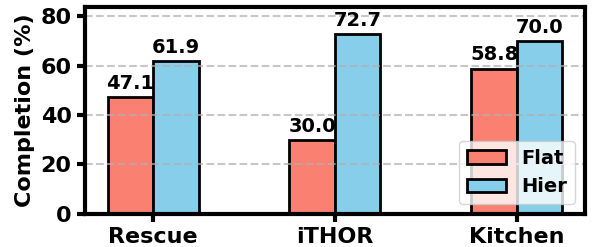
Figure 6. Share of syntactically valid reward candidates that preserve task feasibility.

In every domain, Hier rewards more often still let the agent complete the task.

Q3Does the agent follow the specification?

Domain Method High-Level Low-Level Total
Reward ↑ Expert % ↑ Reward ↑ Expert % ↑ Reward ↑ Expert % ↑
Rescue World Task 11.22 ± 5.57 20.00 −16.46 ± 5.49 0.00 73.80 ± 5.70 0.00
Flat 9.38 ± 7.02 12.50 −2.62 ± 5.19 62.50 85.13 ± 9.33 12.50
Hier 16.65 ± 6.93 76.92 −0.69 ± 1.58 76.92 93.98 ± 9.01 69.23
iTHOR Task 4.10 ± 1.34 0.00 −23.38 ± 1.86 0.00 12.31 ± 0.66 0.00
Flat 7.67 ± 4.48 0.00 −35.20 ± 12.42 0.00 3.27 ± 9.31 0.00
Hier 14.19 ± 2.23 87.50 −3.75 ± 8.14 75.00 37.68 ± 6.68 62.50
Kitchen Task 0.00 ± 0.00 0.00 – – 0.75 ± 0.00 0.00
Flat 0.06 ± 0.13 10.00 – – 0.80 ± 0.12 10.00
Hier 0.39 ± 0.05 92.86 – – 1.08 ± 0.05 92.86

Table 1. Alignment is measured with handcrafted ground-truth rewards. Total is the sum of the task reward and both alignment rewards. Expert % is the share of policies that reach the maximum possible return. Flat and Hier results include only candidates that complete the task.

Hier agents follow the specification best in every domain, even in Kitchen, where a flat reward is theoretically sufficient.

Evaluation with Human Participants

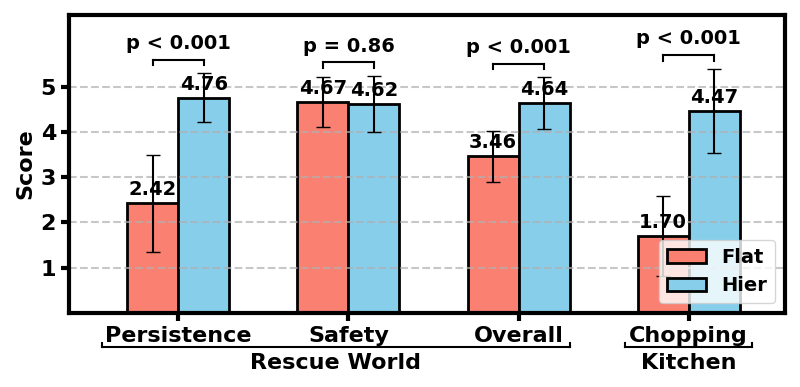
In an IRB-approved study, 30 participants watched videos of Flat and Hier agents in Rescue World and Kitchen, without knowing which was which, and rated how well each followed the specification on a 1–5 scale.

Human ratings of agent alignment

Figure 7. Participants' ratings of how well each agent followed the specification.

Participants consistently rated Hier agents as better aligned than Flat agents on the high-level specifications, which depend on subtask order, and rated the two similarly on low-level safety.

Learned Behaviors

Policies trained with flat vs. hierarchical rewards generated from the same specification.

Rescue World

Task: Deliver all supplies on a disaster-response map.

High-level

Persistence: deliver all objects of one type before switching to the other type.

Low-level

Safety: avoid the yellow danger zones while delivering an object.

Flat

Hier (L2HR)

iTHOR

Task: Move all apples and eggs from the dining table to the sink.

High-level

Diversity: alternate between apples and eggs while both remain on the table.

Low-level

Avoidance: stay away from the stool on the way to pick up or place an egg.

Flat

Hier (L2HR)

Kitchen

Task: Prepare a salad from a tomato, an onion, and a lettuce.

High-level

Chopping order: chop the tomato first, then the onion, then the lettuce.

Low-level

No specification; the low-level policies are fixed.

Flat

Hier (L2HR)

BibTeX

@inproceedings{qian2026hierarchical,
  title     = {Hierarchical Reward Design from Language: Enhancing Alignment of Agent Behavior with Human Specifications},
  author    = {Qian, Zhiqin and Diaz, Ryan and Seo, Sangwon and Unhelkar, Vaibhav},
  booktitle = {Proceedings of the 25th International Conference on Autonomous Agents and Multiagent Systems (AAMAS)},
  year      = {2026}
}